Research Note
Cognitive Credit, 9fin and Octus: A Data Engineer’s Guide to Credit Intelligence Platforms
Preview prompt
Summarize the Ionitsa research note titled "Cognitive Credit, 9fin and Octus: A Data Engineer’s Guide to Credit Intelligence Platforms" for a technical reader.
Cover the problem or research question, implementation or method, evidence or results, and limitations.
Separate facts stated on the page from your own assessment, note anything unclear or unverified, and avoid promotional language.

Primary source: https://ionitsa.com/research/credit-data-platforms.md
Canonical page: https://ionitsa.com/research/credit-data-platforms/
A data engineer’s comparison of structured fundamentals, credit intelligence, document coverage and AI integration across Cognitive Credit, 9fin and Octus.
Funds keep asking the same question in vendor meetings: which credit data platform should we buy?
It is the wrong question.
Cognitive Credit, 9fin and Octus overlap in marketing language. They do not solve the same job. Cognitive Credit is closer to a focused, auditable fundamentals layer. 9fin is closer to a modern analyst workspace connecting data, documents and intelligence. Octus is closer to a broad credit-intelligence system spanning documents, legal analysis and distressed workflows. The useful question is which job your strategy and your systems team actually need done.
Disclosure: I previously worked at Cognitive Credit and later worked on the consumption and integration of financial data within an investment firm. This article is based on publicly available information and general professional experience. It does not disclose confidential information belonging to any current or former employer.
Methodology: This comparison is based on publicly available product documentation, technical materials and company announcements. I have not conducted a controlled production trial of all three platforms. Coverage, delivery methods and permitted data uses may vary by subscription and should be validated directly with each provider.
Why bake-offs fail
Most bake-offs pretend “credit data” is one object. It is not.
In practice the phrase can mean:
- standardised financial statements
- bond and loan reference data
- capital structures
- covenant extraction
- legal documents
- news and proprietary intelligence
- private-credit data
- portfolio monitoring
- AI-ready delivery into internal systems
An issuer in a fundamentals universe may have a complete structured model. An issuer in a document universe may only have filings or news. An issuer on the same platform can have uneven coverage across modules. If you compare headline issuer counts without asking what is actually populated, you are comparing theatre.
This is why three serious products can all look “complete” in a sales deck and still leave different gaps once they hit a portfolio and a production pipeline.
What a hedge fund is actually buying
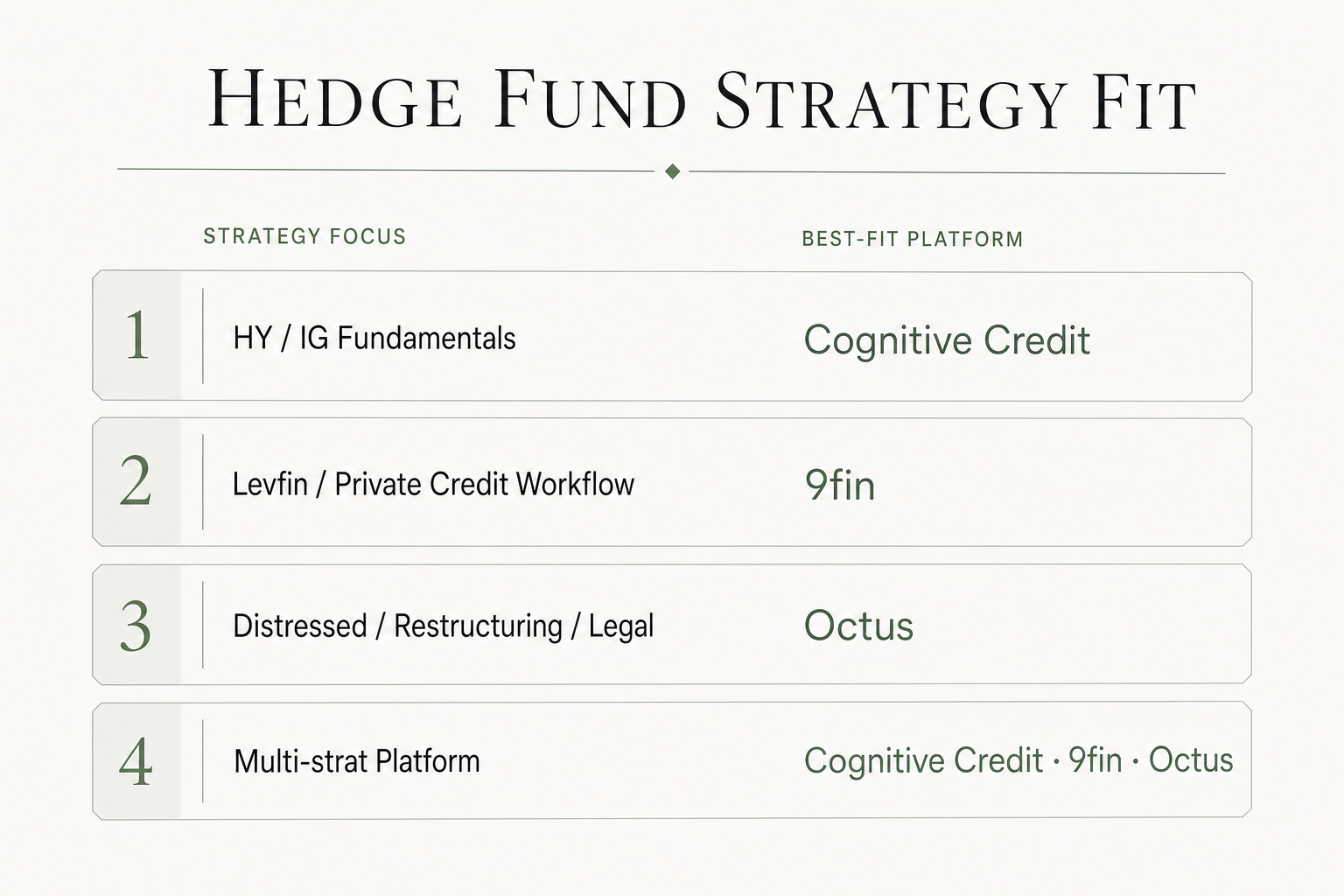
Start from the strategy, not from the feature matrix.
Fundamentals-driven HY and IG credit
If the desk lives in models, ratios, capital structures and point-in-time financials, the scarce resource is trustworthy structured data. Analysts still form the view. The platform’s job is to stop them rebuilding every model from PDFs under time pressure.
Cognitive Credit is a natural starting point for this requirement. Public materials emphasise machine-readable fundamentals, source auditability and API or Excel delivery into internal workflows. For a fundamentals-driven book, that may cover much of the core requirement.
Leveraged finance, private credit and connected research workflow
If the desk spends the day jumping between financials, documents, news, deals and AI search, the scarce resource is continuity. Fragmented tabs are the tax.
9fin is compelling when the priority is a modern research workspace that tries to keep those surfaces connected. The product DNA is technology-led debt intelligence for analysts, bankers, lawyers and investors who need speed across a messy information set.
Distressed, restructuring and legal-heavy credit
If the edge sits in covenants, court documents, restructuring mechanics, journalism and permissioned private documents, you are buying specialist intelligence, not a neat fundamentals table.
Octus, formerly Reorg, has the clearest heritage in that lane. Public positioning spans credit intelligence, legal analysis, documents and institutional delivery across the credit lifecycle, including stressed and distressed work.
Multi-strategy platforms
Large platforms rarely buy one tool for everyone. A HY fundamentals pod, a private-credit origination team and a distressed sleeve can each need a different layer. The expensive mistake is forcing one desk’s workflow onto another desk’s production stack.
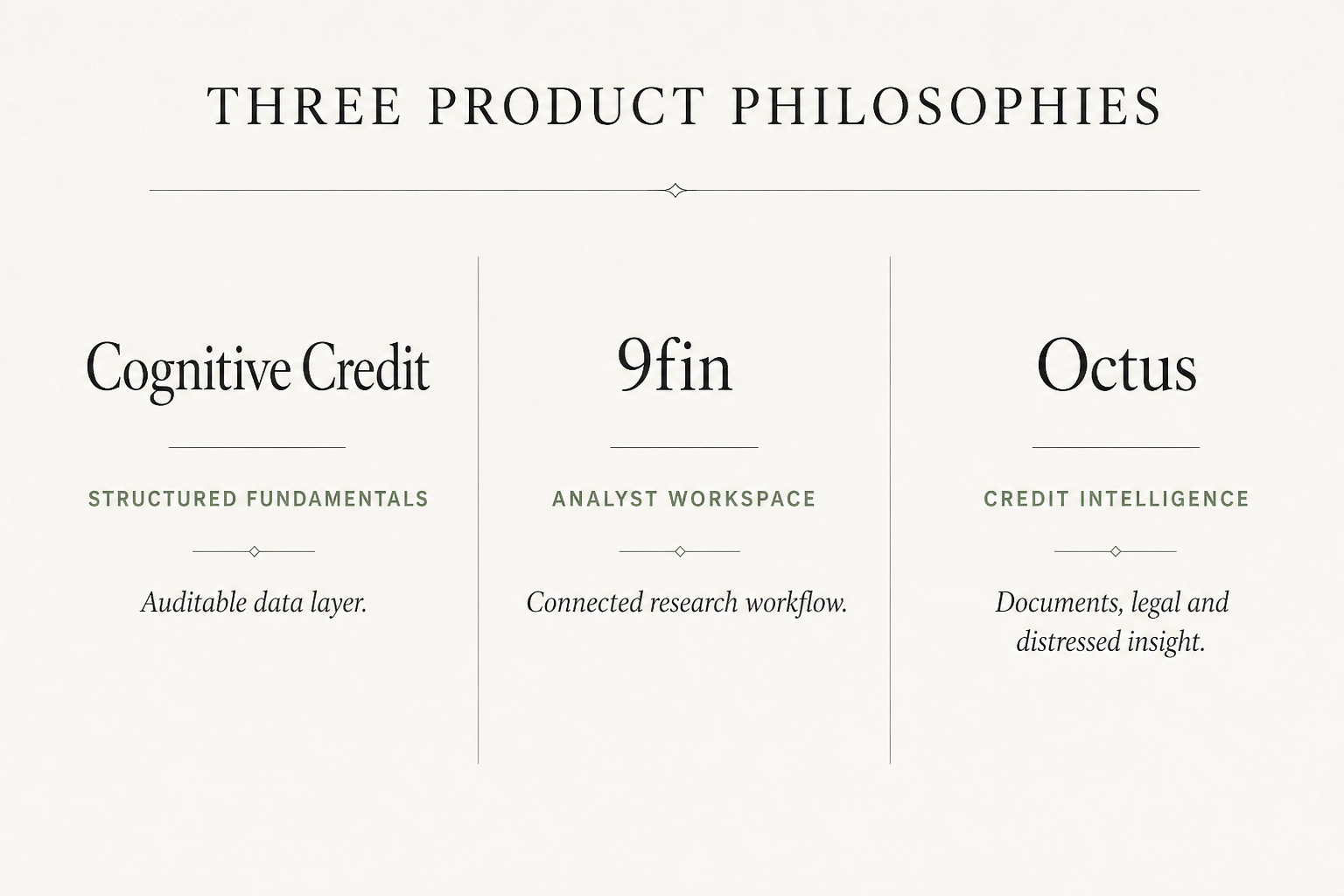
Three product philosophies
Think in product DNA, not feature checklists.
Cognitive Credit
Cognitive Credit is centred on structured and auditable credit fundamentals. The primary unit of value is the data point you can trust enough to put into a model: machine-readable financials, historical and point-in-time analysis, source lineage, and relatively focused API-driven integration. It behaves like a data layer for internal systems more than a full research operating system.
9fin
9fin is centred on a connected research workflow. Financials, documents, news and deals sit inside a technology-led workspace with AI-assisted search. The primary unit of value is continuity for the analyst. It tries to replace several fragmented tools rather than only supply one clean feed.
Octus
Octus is centred on broad specialist credit intelligence. Journalism, legal analysis, covenant expertise, documents and private-credit workflows sit beside enterprise delivery surfaces. The primary unit of value is intelligence plus documents plus specialist interpretation, especially where distressed and restructuring work matters.
The completed acquisition of LevPro, alongside Sky Road, also signals that Octus is moving toward a vertically integrated platform connecting intelligence, portfolio management, monitoring and trading workflows. Octus announced completion of the LevPro acquisition in June 2026 and described the objective as connecting credit intelligence with portfolio-management and trading infrastructure.
Comparison table
| Dimension | Cognitive Credit | 9fin | Octus |
|---|---|---|---|
| Original product DNA | Structured credit fundamentals | Technology-led debt intelligence | Journalism, legal and distressed intelligence |
| Primary unit of value | Auditable data point | Connected research workflow | Intelligence, documents and specialist analysis |
| Main user | Credit analyst or quant engineer | Analyst, banker, lawyer or investor | Credit investor, distressed analyst, legal or restructuring team |
| Fundamentals | Core strength | Part of broader platform | Part of broader platform |
| News | Official-source content rather than proprietary news | Strong | Historical core strength |
| Covenants and legal | More limited | Strong | Major strength |
| Private documents | Restricted issuer workflows, but not a broad document-management platform | Growing private-credit coverage | Strong through FinDox |
| Delivery and implementation surface | Focused API and SDK delivery | Platform, data services and permissioned AI connectivity | API, MCP, Snowflake and Databricks Share |
| Best fit | Internal fundamental-data layer | Modern research workspace | Firm-wide specialist intelligence layer |
| Implementation surface | Narrower implementation surface | Broader data, document and entitlement model | Broad and modular implementation surface |
| AI positioning | Reliable data supplier to AI | AI-native user workflow | AI over verified intelligence and documents |
Coverage is not a single number
Marketing totals can obscure more than they clarify.
Public materials currently emphasise different coverage units. Treat the figures below as company-reported starting points, not as a like-for-like bake-off score:
| Provider | Publicly stated coverage | Important caveat |
|---|---|---|
| Cognitive Credit | 3,100+ bond and loan issuers and 200,000+ official filings | Primarily measures structured fundamentals and disclosure coverage |
| 9fin | 20+ years of bond and loan data across leveraged finance, private credit, distressed, CLOs and related markets | No directly comparable total issuer count is currently published on its main platform page |
| Octus | 95%+ of its defined credit universe, 8M+ private deal documents and 55,000+ annual articles through Direct Data Services | Fundamentals, documents and intelligence represent different coverage universes; other Octus pages currently show different document and content totals, so treat each figure as page-specific and dated |
Ask what “covered” means for each issuer on your list:
- Issuer availability
- Financial completeness
- Instrument mapping
- Historical depth
- Point-in-time reproducibility
- Source lineage
- Document availability
- Covenant coverage
- Update latency
- Correction handling
A representative portfolio beats a global universe slide every time. Give each provider the same issuer list. Request a coverage manifest. Compare field-level completeness, not slogans. Then check whether last quarter’s numbers still reconstruct correctly after restatements.
From the quant side, point-in-time reproducibility and correction handling are non-negotiable. A beautiful UI that cannot answer “what did we know on 15 March?” is research software, not a production dataset.
What integration looks like for a quant systems team
Connecting an API is the easy part. The hard part starts after the first successful response.
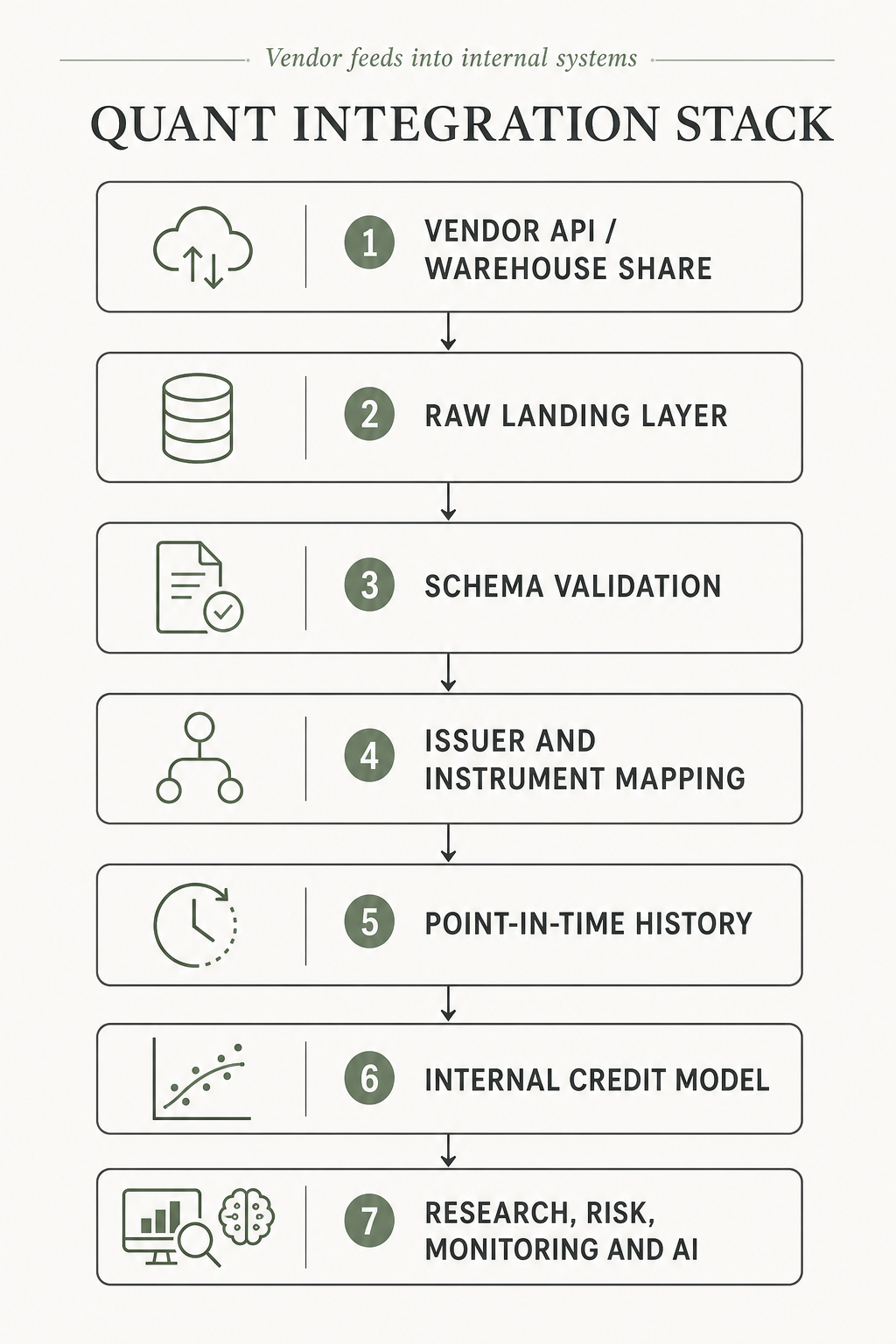
A sober architecture looks like this:
Vendor API / Warehouse Share
            ↓
Raw landing layer
            ↓
Schema validation
            ↓
Issuer and instrument mapping
            ↓
Point-in-time history
            ↓
Internal credit model
            ↓
Research, risk, monitoring and AI
The operational burden sits in the middle:
- mapping vendor entities to internal issuers and instruments
- preserving historical versions
- reconciling corrections
- maintaining source lineage
- applying permissions
- understanding derived-data and redistribution rights
- monitoring missing or stale data
This is where the three products diverge for systems teams.
Cognitive Credit presents a narrower implementation surface when the use case is a focused fundamentals feed. 9fin adds a broader data, document and entitlement model. Octus often presents a broad and modular delivery surface: APIs, warehouse shares, documents and permissioned content. That breadth is valuable. It is also more work to operate as a firm-wide layer.
If your internal security master is weak, every vendor looks worse than it is. Entity mapping is usually harder than authentication. Related systems work on this site includes statistical record linkage for instrument mapping and debt-note bond extraction.
How funds should evaluate the products
A practical checklist:
- Give each provider the same representative list of issuers.
- Request a full coverage manifest.
- Compare field-level completeness.
- Test publication-to-availability latency.
- Verify source links and auditability.
- Reproduce a historical portfolio date.
- Test corrections and restatements.
- Map the data into the internal security master.
- Review storage, redistribution and AI rights.
- Calculate the operational work still required after purchase.
The last point is the one sales processes skip. The purchase price is not the total cost. The total cost includes the engineers who keep the mapping, the controls that catch stale fields, and the legal review of what your models are allowed to retain.
AI does not make trusted data optional
By August 2026, all three providers are moving beyond standalone chat interfaces and into institutional AI connectivity. Cognitive Credit offers a Claude Connector for its structured financials and official disclosure library. 9fin connects its permissioned data, analysis and legal intelligence to Claude, ChatGPT and Copilot. Octus offers both CreditAI and an MCP Connector covering permissioned intelligence, fundamentals and deal documents.
The differentiator is no longer simply whether a vendor has an AI interface. Compare underlying data quality, permissioning, source traceability, historical consistency, entitlement handling, integration into internal AI systems, and the contractual rights to store, transform and expose derived outputs.
AI can make extraction cheaper. It does not automatically solve:
- historical consistency
- entity resolution
- financial normalisation
- auditability
- permissioned documents
- correction handling
- data licensing
- operational accountability
There is a clean distinction here. Extracting a number from a PDF is one problem. Shipping a production dataset that a fund will still trust after a restatement cycle is another. Document extraction pipelines such as the research document data pipeline make that gap concrete: getting text out of a filing is not the same as maintaining a trusted production dataset.
If anything, AI raises the value of suppliers who can provide verified structure, lineage and rights. Models amplify whatever you feed them. Feeding them an unaudited scrape is just faster confusion.
Closing view
Cognitive Credit is a natural starting point for a focused, auditable fundamentals layer. 9fin is a natural starting point for a connected analyst research workflow. Octus is a natural starting point for broad intelligence, legal analysis, documents and distressed or private-credit workflows. Multi-strategy firms may rationally use more than one.
For a portfolio manager, the decisive question is which layer improves the actual research process of the strategy. For a quant engineer, the decisive criteria are field-level coverage, source lineage, historical reproducibility, entity mapping, permissioning, correction handling and long-term operational burden.
There is no universal winner. There is only fit.
If you are mapping a credit-data purchase onto a live portfolio and an internal security master, that design problem is exactly the kind of systems work I take on. The contact page is the shortest route.